
What is PET Fiber
What is PET Fiber, You might not realize that the clothes you wear and the bedding you use every day could be made of PET fiber. Even more surprising is that PET fiber is derived from petroleum processing.
“PET fiber” is the abbreviation for polyester fiber. Fundamentally, they are synthetic fibers. Part of this family is made from petroleum-based components: terephthalic acid (PTA) and monoethylene glycol (MEG). In the world of chemistry, the two are a “dynamic duo.”
I’m sure you’ve played with LEGO bricks, right? Well, their relationship is just like that; without either piece, the final result cannot be achieved. Through a series of chemical reactions, they “marry” and combine to form liquid polyester. These liquid polyester granules then undergo a series of processing steps to become fibers finer than a human hair.
Recycled plastic bottles or plastic waste can also produce polyester fibers. One ton of plastic bottle waste can produce one ton of polyester fiber. The polyester fiber derived from eight plastic bottles is sufficient to manufacture one shirt.
What are the classifications of PET fiber?
PET fiber is like a vast family with many branches, each with a specific role. They are present everywhere in your daily life.
For example, when you wake up in a comfortable bed in the morning, our bed linens and covers are made from solid fibers. These fibers are first spun into threads, then woven into fabric, and finally cut into bed linens. The carpet on your floor is also the domain of solid, coarse-denier fibers. Let me introduce you to this massive family.
1. Virgin Polyester Fiber and Recycled Polyester Fiber
As I mentioned earlier, this vast family consists mainly of two different groups.
Virgin Polyester Fiber
A key component of fiber production is the “love fruit”,which is born from the synergy between PTA and MEG—liquid polyester particles. They look just like jelly beans.
The production process for virgin polyester fiber is very similar to making traditional Chinese sugar figures. You may have seen street vendors crafting these figures—turning a lump of sugar into various cartoon shapes—which are very popular with children. The production process for virgin PET fibers is quite lengthy. First, we melt the polyester particles and process them through an extrusion process to form a continuous polymer stream, which is then spun into fibers and thermally shaped.. Then cut them to a predetermined length before proceeding with subsequent processing steps.
Among these, native polyester fiber stands out as the “top performer” within this family. This material exhibits a pure white appearance and an extremely low defect rate. Consequently, its application requirements are “more complex and advanced.”
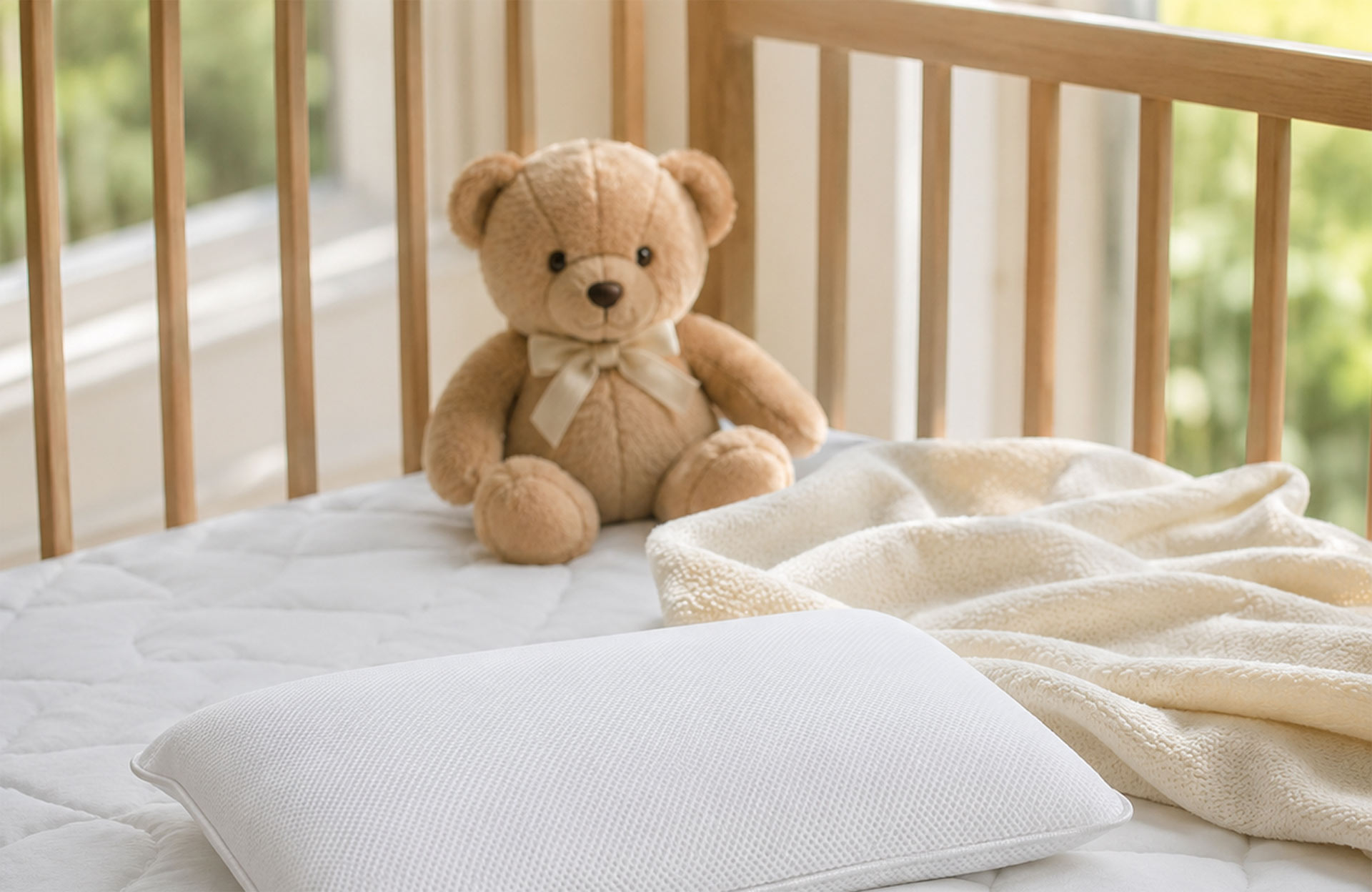
For instance, it often works in pillow cores of hotels and on the breathable fabrics of baby sleepwear. Virgin PET fiber has also become a popular interior filling material for JellyCat dolls in recent years.
Recycled Polyester Fiber
However, as more people join the movement to protect the environment, recycled polyester fiber has emerged as a solution. It is made from discarded plastic waste. Items like plastic bottles and textile waste, will only pollute the environment if we fail to dispose of them properly. However, if we classify them, clean them, melt them, and filter them,then we can convert them into raw materials for polyester fiber production. Producing recycled polyester fiber transforms household plastic waste into valuable material; it is a low-carbon, eco-friendly process that significantly alleviates the burden of waste disposal.
Recycled polyester fiber is also more affordable than natural fibers, appearing in many of the reasonably priced everyday items we use. The throw pillows on your sofa, the inner layers of floor mats, and the standard-issue bedding in dormitories or construction sites are often filled with recycled polyester fiber.

2. Solid Polyester Fiber vs. Hollow Polyester Fiber
Solid Polyester Fiber
Now, imagine with me that there is a bowl of noodles on the table. Lift one noodle and break it; its cross-section forms a complete circle—this is the cross-sectional shape of a solid fiber. Solid fibers possess high toughness and are not easily broken. Therefore, they are commonly used to produce yarn, fabric, and ultimately the clothing we wear.
Hollow Polyester Fiber
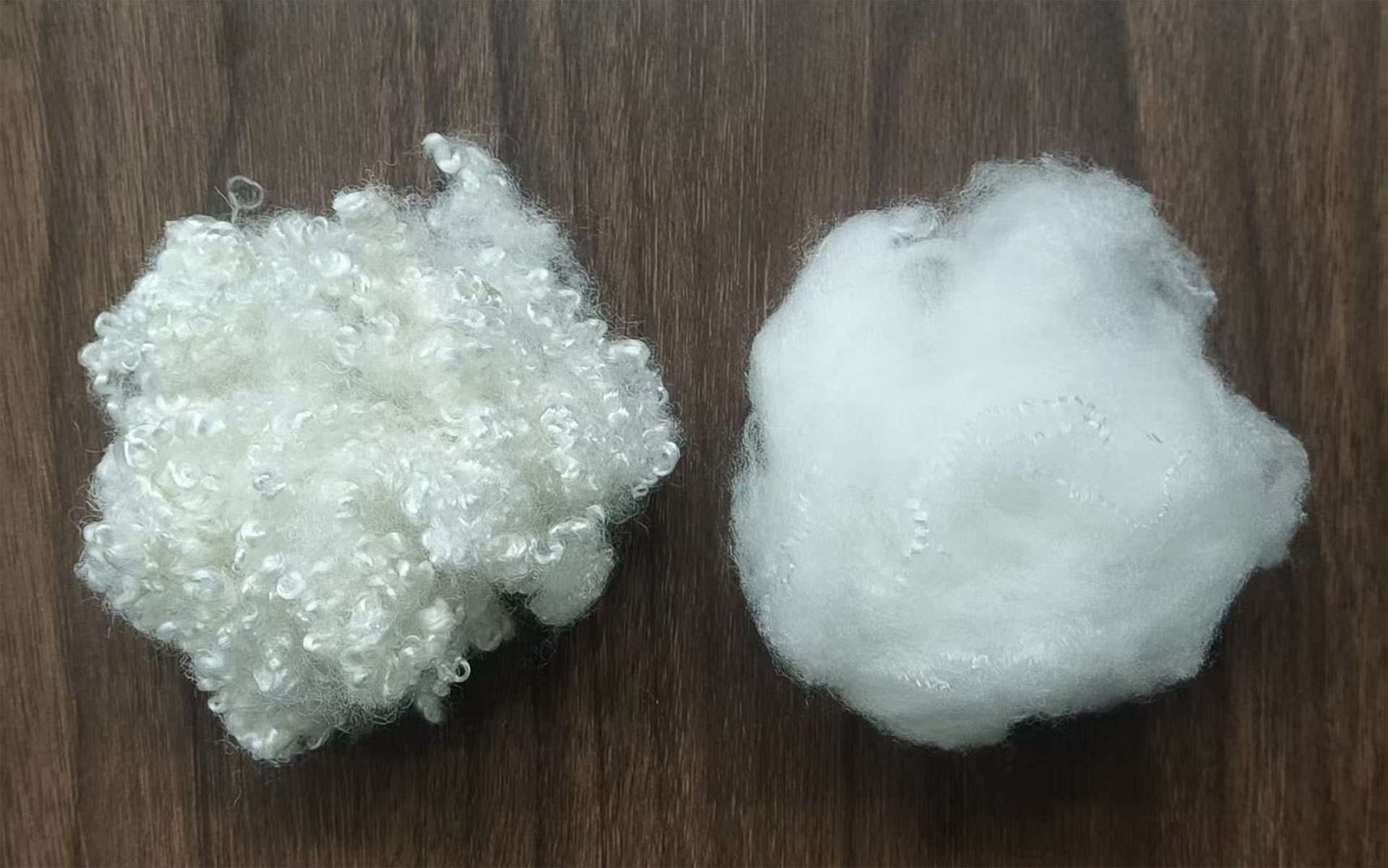
Now imagine that there’s a bowl of hollow noodles on the desktop. The structure of hollow polyester fiber resembles that of hollow powder. Upon cutting it, one can observe varying numbers of pores in the cross-section.
A bowl of the same size filled with hollow fibers contains more hollow fibers than solid ones; since hollow fibers are lighter, it’s easy to see that hollow fibers of the same volume are inherently lighter than solid fibers.
It also resembles a straw held between both ends. The air within the “straw” remains stagnant, thereby enhancing thermal insulation. Consequently, it is frequently used for filling garments or furniture.
Hollow fibers come in various forms. If you lay a strand on a table and fold it into a continuous wave—like a series of V or U shapes—you get a simple, magnified version of a 2D hollow fiber. These are much softer than solid fibers and offer excellent value for money. You will often find them used as filling in affordable throw pillows or mattresses.
When hollow powder is wrapped around chopsticks and then removed, it assumes a spring-like shape—essentially a scaled-up version of three-dimensional hollow fibers. This structure endows it with high elasticity, enabling resistance to vigorous kneading. As the most versatile member of this family, its role is to fill high-rebound pillow cores or premium bedding cores, ensuring everyone enjoys a superior sleep environment.
3. Coarse-denier, regular, fine-denier, and microfiber
Comparing fibers to spaghetti or macaroni helps illustrate whether they have a hollow structure. Naturally, you can also guess that fibers vary in thickness. In the industry, fibers are typically classified by thickness or linear density, with “Denier” (abbreviated as D) serving as the standard measurement unit.
Ultra-fine fibers exhibit a texture and hardness similar to those of brush bristles. These fibers exhibit high hardness and are resistant to bending or deformation.This is both its advantage and its drawback. Due to its high hardness, it is not suitable for contact with the skin. Typically, only manufacturers purchase this fiber for producing industrial nonwovens or industrial felts.
Fibers of regular thickness are closer to human hair—roughly half the thickness of a strand of hair. They are the standard choice for stiffer garments such as outerwear, sportswear, and jeans.
Fine-denier fibers are like the soft, gentle girls of the family; they are slender and have a finer texture.The yarn produced from it yields fabrics that are exceptionally fine and dense, with a texture as smooth as silk.
Your silk-like bed sheets or pajamas, or even high-density down jackets worn in winter, all owe their quality to this material.
4. Raw White Fibers vs. Dyed Fibers
Have you ever wondered what color fibers are when they first come out of the factory? In fact, fibers can come in various colors.
Polyester fibers naturally exhibit a beige color or a slight yellowish hue. This type of fiber have a appropriate name:natural Fiber. After manufacturers produce the fibers into yarn, they can dye them to the desired color later. It resembles pure white paper, designed solely to preserve its natural hue or await the artist’s touch for coloration.
Dyed fibers resemble color-printed cardstock upon appearance. During production, direct color mixing at the raw material blending stage ensures that the entire fiber exhibits a consistent color from interior to exterior. This color adjustment process during pigment mixing achieves high colorfastness, eliminates the need for secondary dyeing, and minimizes color variation between batches.

What are the Advantages of PET fiber?
1. High Cost-effectiveness and Superior Durability
Natural fibers are akin to delicate luxury bags—expensive and requiring meticulous care during use, prone to damage with prolonged exposure.
Polyester fibers, much like military-grade backpacks, are not only more affordable but also highly durable.Even if you leave it in the washing machine for several days without removing it, it won’t deform or wear out. Or if you store it at the bottom of the lower compartment for a year, it’ll remain in perfect condition. Their low cost makes comfortable household products accessible to everyone and enables more children to purchase affordable toys.
2. A Better User Experience
Polyester fibers act like “impervious springs” —they neither absorb moisture nor easily become flattened. Clothing made from them does not absorb sweat or remain damp, thus preventing the growth of mites and mold.
In contrast, natural fibers tend to absorb water and sweat more readily.We need to air-dry and gently pat this fiber to make it fluffy, though this effect is only temporary. When rolled on bedding filled with natural fibers, the bedding will quickly become very flat.
In summary, polyester fibers offer significant advantages in terms of cost and user experience—key reasons for their widespread popularity.
What Factors Affect the PET Fiber Price?
1. Raw Material Quality and Market Price
If polyester fiber is like noodles, then the polyester raw material is flour. A key factor influencing the price of polyester fiber is the price of this “flour”; when the price of the “flour” fluctuates, the price of the fiber goes on a roller-coaster ride as well. Additionally, the level of impurities and color purity of the raw materials also affect the fiber’s price.
2. Fiber specifications, manufacturing processes, and customization requirements
The complexity of fiber length, structure, and dyeing techniques significantly impacts pricing. It’s like ordering noodles at a noodle shop—the basic package is the cheapest.
If you want to add vegetable juice to color the noodles or switch to hollow-noodle variety, the price will be higher. Products such as three-dimensional hollow fibers and custom-dyed fibers involve more complex manufacturing processes, resulting in higher prices compared to conventional fibers.
3. Order Volume
Large-volume orders—whether for stock items or custom production runs—offer lower unit prices and better value. Conversely, small-batch orders requiring custom colors or specific lengths may see price variations due to the increased startup waste associated with production.
4. Quality Standards and Product Consistency
Fibers that meet higher quality standards—such as batch-to-batch color consistency, color fastness, opening performance, and impurity control—are priced higher. Producing such fibers entails higher quality control costs, resulting in a higher overall price point compared to standard commodity-grade products. However, high-quality polyester fiber can help downstream customers reduce defect rates and improve production efficiency.
PET Fiber—Our Great Companion
PET fiber is not only an indispensable raw material in industrial production but also a great companion in our daily lives. It appears everywhere in our lives, like carpets and mattresses to small objects like plush ornaments. After reading this article, perhaps the next time you cuddle a plush toy, you’ll be curious to see what kind of fiber is inside.
Post time: Jul-08-2026