
Polyester usually resists wrinkles better than many natural fibers, but it is not wrinkle-proof. The result you see depends on more than the fiber name: yarn or web design, finished construction, blend, thickness, heat history, finishing, pressure, and storage all matter. This guide gives you the short answer first, then shows how to judge a finished material with representative samples and a named test method.
Does Polyester Wrinkle? The Short Answer
Yes, polyester can wrinkle. In a typical comparison, it often recovers from bending or compression more readily than cotton or rayon, so it may look smoother after ordinary wear. That is a tendency, not a guarantee. A loosely built material, a polyester blend, a sharp load, or a hot process can leave a crease that remains visible.
The useful distinction is between fiber resilience and finished-material wrinkle performance. A resilient fiber tends to move back toward its earlier shape. Wrinkle resistance describes how much a material resists visible creasing during use. Wrinkle recovery describes what happens after a crease has been introduced. Crease recovery may be reported with an angle method. These terms overlap in conversation, but they are not interchangeable test results. Shrinkage and moisture absorption are separate properties as well.
Why Polyester Usually Resists Wrinkles
Polyester is a thermoplastic synthetic fiber. Its molecular structure and processing history allow it to retain a set shape and recover from some temporary deformation. Textile education references such as the University of Georgia fiber guide describe polyester as wrinkle-resistant and able to retain heat-set pleats. That is a useful explanation of the fiber’s normal tendency, not a performance certificate for every fabric or nonwoven.
Resilience is the main reason a polyester-containing material may look neat after bending. If the load is modest and the structure can move back, the surface may flatten without ironing. Heat-setting can reinforce this behavior by fixing a selected geometry while the material is held and cooled. The setting is part of the product history; it is not a permanent promise attached to the word “polyester.”
This is also why a label cannot answer every development question. The label may tell you the polymer family or blend percentage, but not the yarn twist, web bonding, fabric density, thickness, finish, or thermal history. It also cannot tell you how a representative finished sample will look after a defined load or laundering cycle.
Why Polyester Can Still Wrinkle
Several different events can create a visible crease even when the fiber has good recovery potential.
A concentrated load can exceed recovery
Folding, compression in a package, sitting pressure, or a sharp edge can deform the yarns or bonded web more than ordinary movement does. If the material is held in that position, the deformation can become harder to remove. A light, open construction may show the load more clearly than a stable, dense one, even when both use the same polymer.
Blends share the result
Cotton, rayon, wool, elastane, or another polymer changes the balance of bending, moisture response, and recovery. A polyester-rich blend may recover better than the non-polyester component alone, but the final result still belongs to the blend and its construction. Do not turn “contains polyester” into “will not wrinkle.” Ask which component controls the surface behavior in the finished structure.
Wet heat and cooling can reset the shape
Polyester can soften enough under heat for chain segments to move. Cooling then helps hold the geometry present at that moment. The J-STAGE study on cooling during polyester heat-setting reports that cooling conditions affected crease-recovery behavior under its experimental conditions. The practical lesson is simple: record the heating, tension, cooling, and handling sequence instead of recording only a peak temperature.
Storage and finishing add their own history
Finishes can change hand, friction, stiffness, or surface appearance. Rolling, stacking while warm, or leaving a material under pressure can introduce a crease after production. A finished sample that looks smooth on a table may behave differently after transport or assembly. That is why a claim needs a sample state and a method behind it.
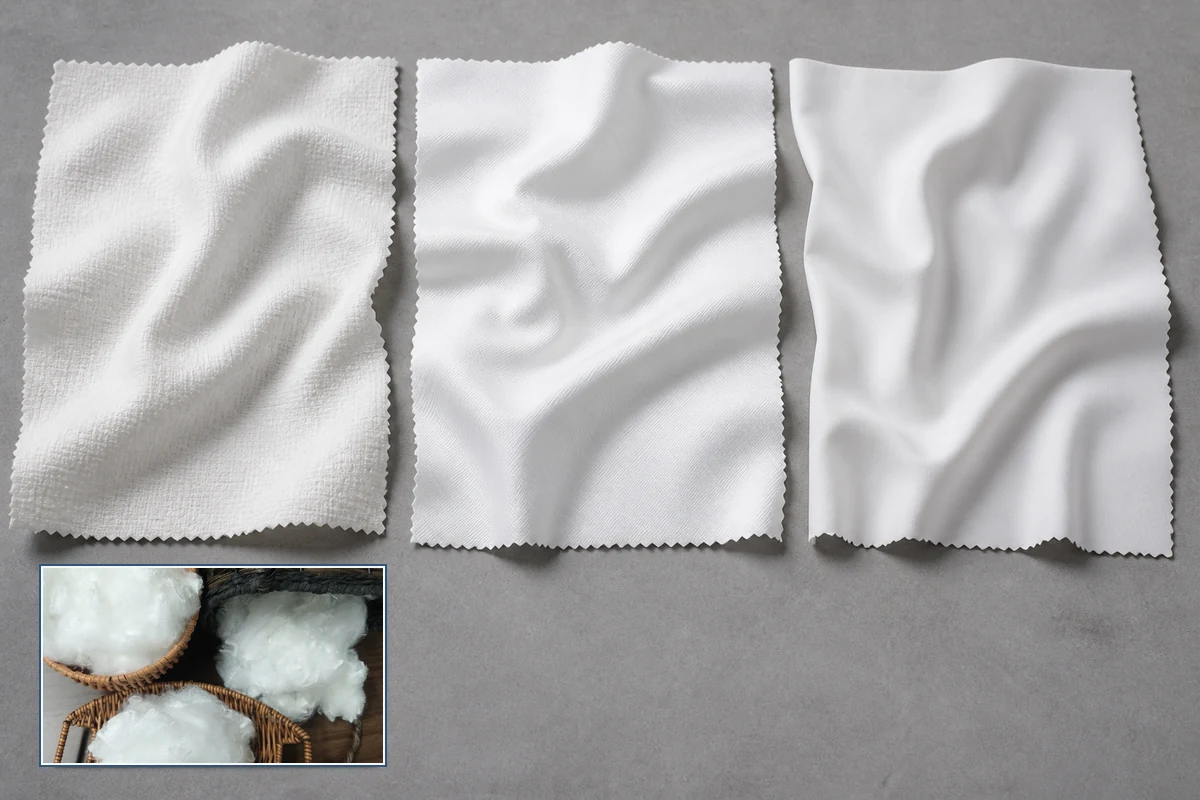
How Fiber, Yarn, and Finished Structure Change the Result
The same polyester chemistry can behave differently as fiber, yarn, fabric, nonwoven, or a multilayer component. Use the following layers when you investigate a wrinkle complaint.
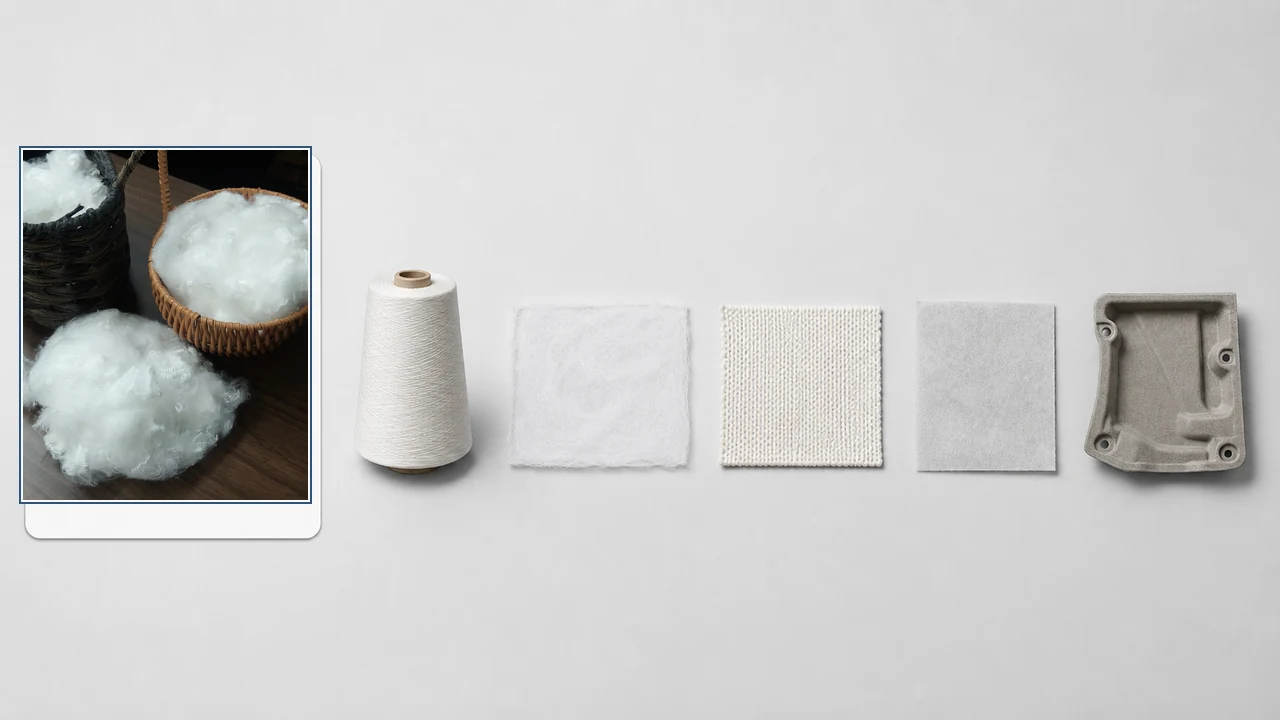
| Material layer | What can change | What you can learn |
|---|---|---|
| Fiber or PSF | Length, fineness, crimp, surface treatment, and blend share | The starting recovery tendency and how fibers interact |
| Yarn or fiber web | Twist, bulk, orientation, bonding, and tension | How easily elements move under a load |
| Fabric or nonwoven | Knit/woven pattern, basis weight, thickness, density, and direction | Whether the structure spreads or concentrates a crease |
| Finished component | Lamination, coating, seams, filling, and thermal history | The appearance a customer actually sees |
GSM or thickness is therefore a development variable, not a universal ranking. A heavier material may resist a casual fold yet hold a set crease if it is compressed while warm. A lighter web may recover quickly in one direction and show a ridge in another. The relevant comparison is between representative samples with the same construction and end-use load.
You can also separate the direction of the material. Woven samples may differ in warp and weft; knits may differ along wales and courses; nonwovens can have a web orientation or bonding direction. If a supplier gives one wrinkle value without a direction or sample description, the number is difficult to use for a real product decision.
How Heat-Setting and Finishing Affect Wrinkle Recovery
Heat-setting is a controlled way to stabilize dimensions and shape in thermoplastic materials. A stenter or another finishing line may apply width, overfeed, tension, heat, cooling, and a chemical finish in sequence. The exact recipe belongs to the material, machine, and target construction. A general blog temperature window is not a specification for your process.

The questions that matter are more practical:
- Was the material relaxed, stretched, or held at width before heating?
- Was it cooled while still under tension, or stacked while warm?
- Was the finish applied before or after the main thermal step?
- Did later dyeing, bonding, lamination, or molding add another heat history?
- Was the sample tested before or after the final process?
The answers help you locate the source of a wrinkle. If the fiber looks sound but the finished surface changes after a later thermal step, the issue may be geometry or process sequence rather than polymer selection. If a blend changes after laundering, the components may relax at different rates. This is why “heat-set” is useful information but not a complete claim.
How to Evaluate a Finished Material
Start with a representative sample. A loose fiber tuft or a supplier’s promotional swatch cannot stand in for the yarn, web, fabric, nonwoven, filling package, or assembled component that will reach the customer. Record composition, construction, basis weight or thickness, direction, finish, and the process stage represented by the sample.
Then choose a method that matches the question. AATCC TM128 and ISO 9867:2022 evaluate the appearance of textile fabrics after induced wrinkling. Their published descriptions cover fabrics made from any fiber or combination and distinguish original or laundered states. The specimen is wrinkled under controlled conditions, reconditioned, and compared with three-dimensional references.
That is not the same as an angle test. AATCC 66 and ISO 2313 are used for crease recovery of a folded specimen by measuring a recovery angle. The angle route and the random-wrinkle appearance route answer related but different questions. A result from one method should not be presented as if it were the other.
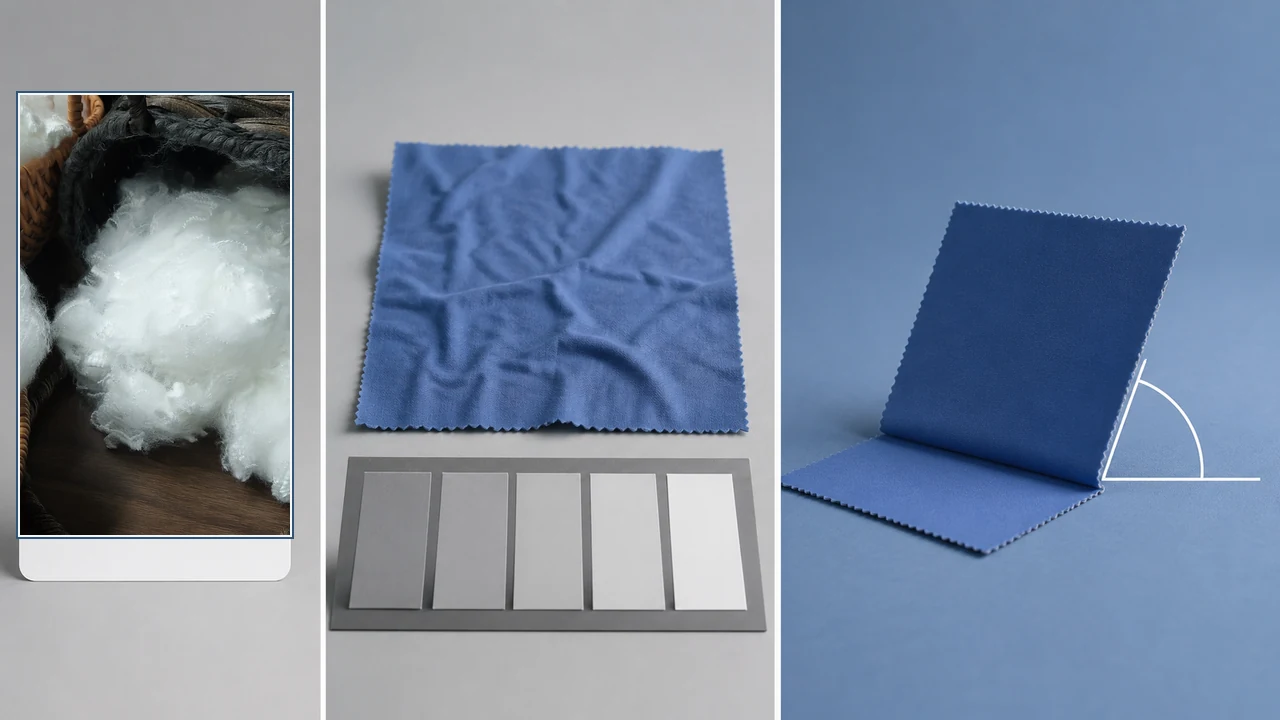
Before you compare reports, check these fields:
| Report field | Why it matters |
|---|---|
| Sample identity and construction | Confirms the result belongs to the material you will use |
| Fiber/blend composition | Separates polymer effects from blend effects |
| Direction and specimen preparation | Prevents a warp, weft, wale, course, or web direction from being hidden |
| Conditioning and waiting time | Recovery can change while the specimen relaxes |
| Load, time, washing, and drying state | Defines the deformation the result actually represents |
| Method and edition | Prevents an appearance grade from being compared with an angle result |
| Photos, grade, angle, or other output | Shows what was measured and how it was judged |
If you are sourcing PSF for a downstream product, use the Polyester Staple Fiber Buying Guide to organize the upstream specifications you need to discuss. The guide can help structure a supplier conversation; it cannot replace testing on a representative finished sample.
What This Means for PSF Development and Purchasing
For an R&D team, the useful question is not “Which polyester never wrinkles?” It is “Which combination of fiber, structure, process, and end-use load gives the required appearance after the agreed conditioning and test?” That question leaves room for a fiber change, a yarn or web change, a finishing adjustment, or a better sample plan.
For purchasing, ask for the claim in a form another supplier could reproduce. Request the sample composition, construction, direction, finish, test method, conditioning, and comparison basis. If the supplier only sends a phrase such as “easy care” or “wrinkle-free,” treat it as a starting claim rather than a finished specification.
For nonwoven or filling applications, remember that surface appearance may be controlled by bonding, loft, cover material, quilting, or compression rather than by PSF alone. A staple fiber can contribute to recovery, but the assembled component owns the final result. That distinction keeps the conversation technically fair and prevents an upstream material from carrying a guarantee it cannot make by itself.
FAQ
Does 100% polyester wrinkle?
Yes. 100% polyester often has good wrinkle resistance, but the finished material can still crease under compression, wet heat, poor cooling, loose construction, or long storage. “100%” describes composition only. It does not describe yarn design, web bonding, thickness, finish, or the test state. For a product decision, judge the representative finished sample rather than the fiber percentage alone.
Does polyester crease more in a blend?
It can, depending on the other fiber and the construction. Cotton, rayon, wool, or elastane may change bending, moisture response, and recovery. Polyester can improve a blend’s tendency to return toward a flat shape, but the blend still needs its own evaluation. Compare the same construction, direction, weight, finish, and conditioning rather than assuming a higher polyester percentage always gives the best appearance.
Is wrinkle recovery the same as shrinkage?
No. Wrinkle recovery describes how a material returns after a crease or wrinkling load. Shrinkage describes a dimensional change after relaxation, washing, drying, or heat. A sample can recover from a crease and still shrink, or remain dimensionally stable while showing a surface wrinkle. Keep the two questions separate in specifications, test requests, and page planning so one result does not replace the other.
Can heat-setting make polyester wrinkle-proof?
Heat-setting can stabilize a selected geometry and improve shape retention, but it does not make every later deformation disappear. Tension, cooling, finishing, later bonding, storage pressure, and laundering can change the final surface. Treat heat-setting as one part of the process history. A wrinkle-resistant claim still needs a defined finished sample, method, conditioning, and result rather than a generic process label.
How should a nonwoven buyer judge polyester wrinkle performance?
Use a representative web or assembled component, not loose PSF alone. Record fiber blend, orientation, bonding, basis weight, thickness, loft, cover layers, and compression history. Decide whether the concern is random surface wrinkling, a sharp crease, or dimensional change, then select a matching method. A nonwoven can respond differently from a woven fabric even when both contain the same polyester polymer.
Can washing make polyester wrinkle?
Yes. Washing, spinning, drying, and cooling introduce moisture, movement, temperature, and pressure. A well-designed polyester material may relax smoothly, while another structure can retain a crease if it is compressed or cooled in the wrong shape. Consumer care instructions may help a garment, but they are not a substitute for a production validation. For development, compare the agreed wash-and-dry state on a finished sample.
Which test should you request: AATCC 128 or a recovery angle method?
Ask what visual or mechanical question you need answered. AATCC TM128 and ISO 9867 describe appearance after induced wrinkling and comparison with three-dimensional references. AATCC 66 and ISO 2313 use a folded specimen and recovery angle. They are related but not interchangeable. Your request should name the method, edition, sample direction, conditioning, load, waiting time, and the output used for acceptance.
Final Thoughts
Polyester is usually a useful starting point for wrinkle resistance, but the finished material—not the fiber name—decides the result. Your next step is to compare a representative sample with its construction, heat history, conditioning, and named test method recorded. When that process begins with PSF specifications, the Polyester Staple Fiber Buying Guide can help organize the questions without replacing finished-material validation.
Post time: Aug-26-2026