
Polyester can be breathable, but a fiber label cannot predict the finished material. Airflow and moisture comfort depend on how the fiber becomes yarn or a web, then a fabric, nonwoven, finish, or complete component.
If you are comparing polyester materials, this article separates air permeability, vapor resistance, absorption, wicking, and drying, then shows which structure details and finished-sample evidence help you judge a specific material.
What Does “Breathable” Mean for Polyester?
In textile specifications, breathable is an umbrella term, not a single universal performance score. When you read the word in a product brief, you still need to identify what is actually moving through—or out of—the material. Five related properties are often hidden inside that one word.
| Property | The question it answers | Typical test object | What it does not prove |
|---|---|---|---|
| Air permeability | Can air pass through the material under specified conditions? | Fabric, nonwoven, textile product, or layered sample | Wicking, drying, or overall comfort |
| Water-vapor transfer or resistance | How readily does water vapor move through the material, or how strongly is it resisted? | A material or multilayer assembly | Direct airflow or liquid-water spreading |
| Moisture absorption or regain | How much moisture enters and remains within the fiber or material under defined conditions? | Fiber or material in a controlled state | Air permeability or surface wicking |
| Wicking or liquid moisture management | How does liquid wet, spread, or move along and through a textile? | Fabric or nonwoven, with its face and direction identified | Water-vapor resistance, airflow, or automatic fast drying |
| Drying | How quickly does water leave a wet textile under the stated method and conditions? | Wetted fabric, nonwoven, or a sample taken from a product | Wicking direction, airflow, or drying in every use environment |
This separation resolves several apparent contradictions. Polyester can absorb relatively little moisture into the fiber while a designed textile moves liquid along its surfaces. A sample can spread sweat effectively yet allow little air through. Another may pass air readily but dry slowly under a particular test condition. None of these results is impossible; they simply describe different transport tasks.
For a useful material specification, replace a broad request such as “breathable polyester” with the property your application needs. Then identify the representative sample and evidence for that property. Air permeability, water-vapor behavior, absorption, wicking, and drying can all influence moisture comfort, but one result should never be presented as proof of the other four.
What Controls Airflow Through Polyester Materials?
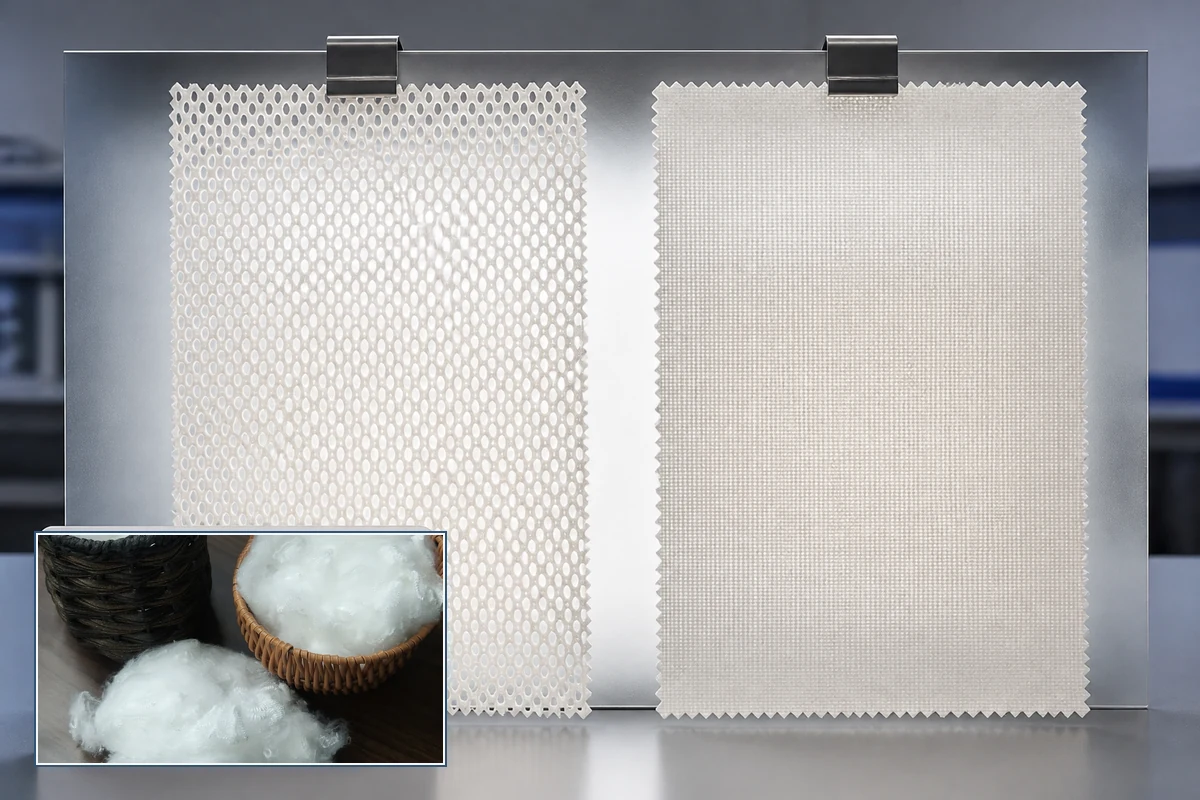
Air needs a connected route through a textile. If you are checking airflow, remember that this route is formed by spaces between fibers, yarns, loops, bonded areas, and layers—not by the polymer name alone. Air permeability therefore belongs to the finished structure tested in a defined state.
Five groups of variables deserve attention when airflow is the target:
- Yarn or web arrangement. Yarn diameter, packing, twist, bulk, and the way fibers are distributed in a nonwoven can change the size and continuity of air paths. No single yarn label predicts the finished result.
- Fabric construction and cover. Loop geometry, weave, stitch density, bonded areas, and open zones determine how much of the surface offers a connected passage. An open mesh will often provide more direct routes than a dense construction, but mesh, knit, and woven are categories, not performance grades.
- Mass and thickness. GSM and thickness help describe a sample and may explain differences between otherwise similar structures. Neither field works as a universal cutoff: a light textile can still be tightly covered, while a thicker structure may contain connected pores.
- Finishing and assembly. Calendaring, heat and pressure, coatings, membranes, laminates, linings, and additional layers can narrow, block, or redirect airflow. A breathable face fabric does not establish the behavior of the complete component.
- Sample state. Moisture, stretch, compression, orientation, and edge sealing during testing can alter openings or the measured path. Data from a flat, dry sample may not describe the same material when you stretch, wet, compress, or combine it with an outer shell.
These variables also explain why two materials carrying the same “100% polyester” label can feel different. One may be a light, open construction made for ventilation; another may be dense, coated, or multilayered to limit air movement. The composition is the same, but the connected pore network is not.
Airflow is therefore a structural response, not a fiber ranking. Opening one pathway can also change wind resistance, filtration, protection, or containment, so the useful direction comes from the end use. Polyester identifies the fiber family; the connected pore network determines how readily air passes through the material.
How Can Polyester Wick Moisture If It Absorbs So Little?
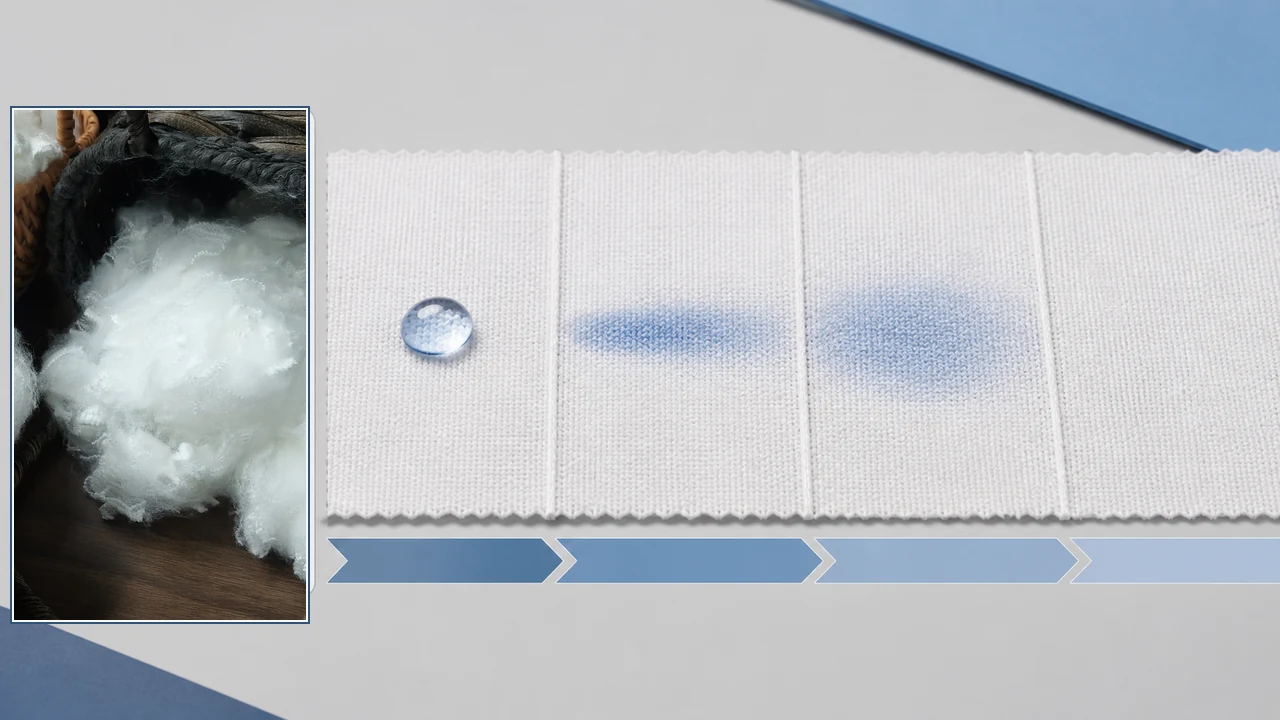
Low moisture regain describes how little moisture polyester takes into the fiber itself under specified conditions. It does not describe every route available to liquid sweat. Water can remain mainly outside the fiber and still move along wetted surfaces and through capillary spaces between fibers, yarns, or parts of a nonwoven web.
That movement requires a usable pathway. Fiber cross-section and surface condition may contribute, while yarn packing, web formation, fabric construction, and different structures on the two faces can determine whether the pathway remains connected. A grooved or otherwise shaped cross-section can provide potential surface channels, but its shape alone does not guarantee that liquid will wet those channels or travel effectively through the finished material. A hydrophilic finish can change surface wetting, yet its initial effect does not establish performance after washing or prolonged use.
It helps to view sweat handling as a sequence:
- Wetting: liquid first makes contact with a surface.
- Transport: capillary paths may move it along or through the textile.
- Spreading: the liquid may occupy a larger exposed area.
- Drying: water then has to leave the material under the surrounding temperature, humidity, and airflow.
Each step answers a different question. Fast spreading is not the same as high fiber absorption, and a strong wicking result does not prove fast drying. Drying also depends on the starting water load, how much the structure holds, its mass and thickness, the exposed area, and the test environment. High humidity or limited air movement can slow evaporation even after liquid reaches the outer surface.
Air permeability remains separate from this liquid pathway. A material may wick along connected fiber surfaces while allowing little air directly through its thickness; another may pass air through large openings without moving liquid well. The same separation applies to drying: transport may increase the exposed area, but evaporation still responds to water load, thickness, humidity, and air movement. Low regain leaves room for a deliberately built surface-and-capillary system, but it does not make wicking an inherent property of every polyester structure.
From Polyester Fiber to a Finished Performance Result
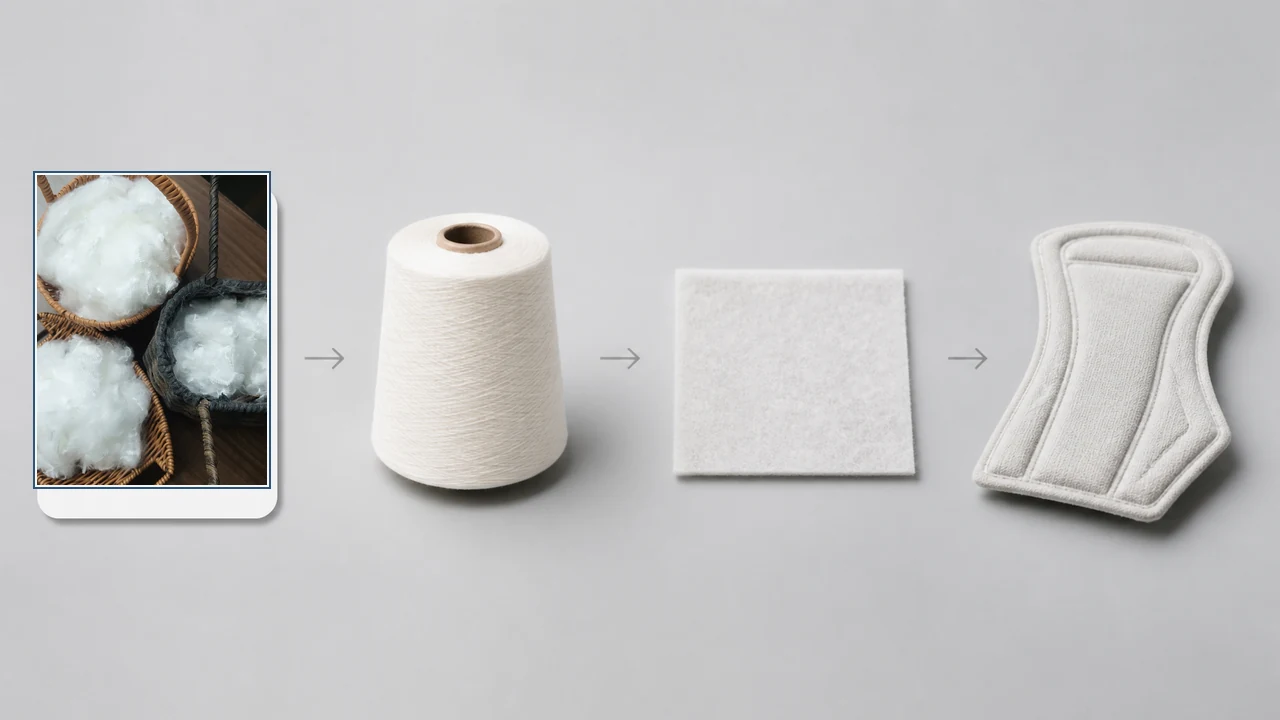
A finished performance claim should follow the material through its processing chain rather than travel backward from a raw-material name. Each layer changes the available structure, and each supports a different level of technical statement, with its own decision owner and evidence boundary.
| Decision level | Inputs and responsibility at this level | Decision handoff |
|---|---|---|
| Fiber or PSF | Fineness, cut length, crimp, cross-section, solid or hollow form, and surface condition define the processing start and potential surface or bulk characteristics | Carry the selected specification into yarn or web development |
| Yarn or web formation | Spinning or web route, packing, twist, bulk, fiber distribution, and bonding shape pore and capillary continuity | Confirm how the intended pathways survive in the fabric or nonwoven |
| Fabric or nonwoven | Knit, weave, or bond structure; cover; GSM; thickness; porosity; faces; and direction create the working network | Review finishing, added layers, and the expected use state |
| Finish and assembly | Wetting finish, calendaring, coating, membrane, lamination, lining, quilting, shell, and compression alter surfaces and paths | Build the representative component before acceptance |
| Representative test | Finished sample, orientation, state, method, version, unit, conditions, and result support a property at the tested level | Limit the claim to the property and sample described in the report |
This chain separates a design input from an acceptance result. A fiber specification can make a downstream structure possible, but yarn formation or web bonding may preserve, change, or close the intended pathways. Fabric construction then sets the working geometry, and finishing or assembly can alter it again. The result belongs to the representative sample, not to an isolated field copied from an upstream data sheet.
The distinction is especially important for nonwovens and filling components. Air paths can change with web density, basis weight, thickness, bonding, compression, quilting, and the surrounding shell. Testing loose fiber alone cannot establish how the assembled component will behave.
Responsibility moves forward with the material. Fiber data inform yarn or web design, and intermediate structure data inform fabric, nonwoven, and assembly decisions. No upstream row independently establishes downstream performance. When a layer changes, reconsider the claim at the level where that performance is actually owned.
Is Polyester Breathable Enough for Your End Use?
“Enough” is an application requirement, not a universal polyester grade. Define what must pass through the material, its use state, and the functions that must remain. Higher air permeability may help one product but undermine wind resistance, filtration, protection, or thermal performance in another.
| End-use context | The performance question | Representative evaluation level |
|---|---|---|
| Lightweight or next-to-skin textiles | Does the structure provide the required airflow, liquid-sweat movement, and drying as separate properties? | The finished fabric in the relevant orientation and state |
| Outer, wind-resistant, or protective textiles | How much airflow is compatible with the barrier, and what water-vapor behavior is required separately? | The coated, laminated, or otherwise finished textile |
| Nonwoven sheets and technical layers | Do web density, bonding, thickness, and finishing provide the intended air passage without losing the main function? | The finished nonwoven at its specified basis weight, thickness, and test state |
| Filling and insulation components | What balance is required among air movement, warmth, loft, compression, and durability? | The fill together with its shell, quilting, or containment structure |
| Multilayer assemblies | Does the complete stack meet the airflow or water-vapor target? | The assembled system in its intended order |
Hot or humid use adds a condition, not a new material ranking. Your open textile may provide air paths, while sweat evaporation can still slow in high humidity or limited air movement. Wicking therefore does not establish airflow, and air permeability does not establish liquid-sweat handling.
Define the end-use function first, then set separate targets for the properties that matter. The right construction meets those requirements in a representative sample; it is not simply the one with the highest unrelated result.
How to Evaluate a Specific Polyester Material
Evaluation starts by turning a broad claim into a testable question. You can use the following sequence before comparing suppliers:
- Define the end use and claim. Decide whether your requirement concerns direct airflow, water-vapor resistance, liquid transport, drying, or more than one independently measured property.
- Describe the representative sample. Record your fiber content, yarn or web route, construction, GSM, thickness, faces, direction, finishing, layers, and any relevant wet, stretched, or compressed state.
- Match each claim to a method. Select a method whose stated object and scope correspond to the material and property. Do not use one result as a substitute for another.
- Compare on a common basis. Check the method version, unit, sample state, conditioning or test conditions reported, and the actual result before you rank data from different sources.
- Confirm durability and assembly effects. If a claim depends on a finish or if the product is washed, stretched, compressed, laminated, or combined with a shell, decide which post-treatment or assembled state must be verified.
| Claim to verify | Method entry point | What the report should identify | What the result cannot establish |
|---|---|---|---|
| Air permeability | ASTM D737 or ISO 9237 | Method and version, finished sample, state, unit, conditions, and result | Water-vapor behavior, wicking, drying, or overall comfort |
| Water-vapor resistance | ISO 11092:2026 | Material or multilayer assembly and the reported result | Direct airflow or liquid-water movement |
| Liquid moisture management | AATCC TM195 | Actual fabric or nonwoven, tested face or direction, and result | Air permeability, water-vapor resistance, or drying rate |
| Vertical or horizontal wicking | AATCC TM197 or TM198 | Sample orientation, face, direction, method version, and result | The other direction, drying, or a complete comfort claim |
| Drying time or rate | AATCC TM199, TM200, or TM201 | The specific method, starting sample state, stated conditions, and result | Natural drying in every environment or any unmeasured transport property |
These are method entry points, not universal product specifications. Public method summaries do not provide a single pass line for all polyester materials, and results from different methods should not be treated as one scale. A report is useful only when its sample matches the product being considered.
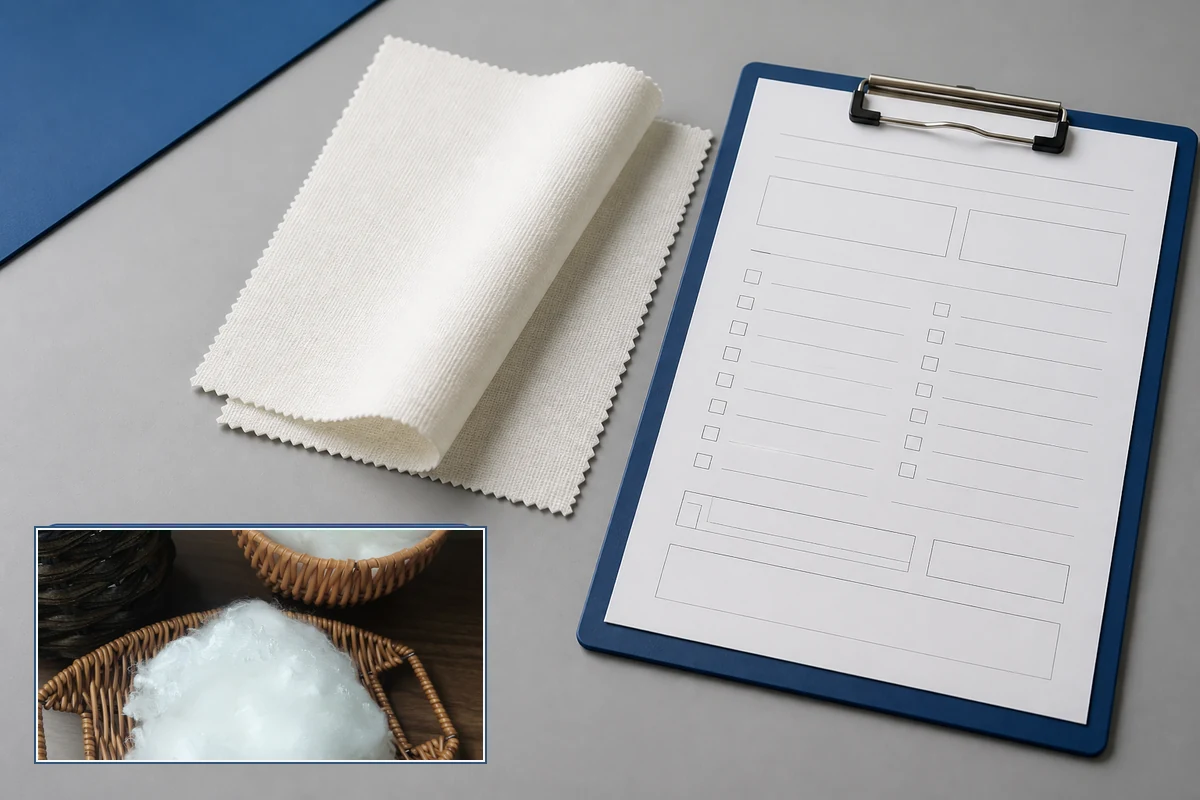
Keep a short comparison sheet with your end use, sample level, construction, finish, test direction, sample state, method, version, unit, conditions, and initial or post-treatment result. If a layer or process changes, review whether the previous evidence still represents the finished material.
For upstream sourcing, the Polyester Staple Fiber Buying Guide can help organize PSF specifications around the downstream process and end use. It complements rather than replaces testing on the representative yarn, web, textile, nonwoven, or assembled component.
Frequently Asked Questions About Polyester Breathability
Can 100% polyester be breathable?
Yes. If you are selecting a 100% polyester material, it can allow substantial airflow when its fibers or yarns form an open, connected structure. Dense, coated, laminated, or multilayer versions with the same fiber content may restrict air instead. The label identifies composition, not a breathability rating, so the finished fabric, nonwoven, or component is the meaningful level for judgment. Any result belongs to that specific construction.
Does polyester make you sweat more?
No. Polyester content alone does not determine how much a person sweats; activity, temperature, and humidity matter. What the material can change is the local experience: a dense or poorly ventilated structure may retain heat or liquid and feel clammy, while a more open or purpose-designed structure may manage those conditions differently.
Is polyester breathable in hot weather?
Sometimes. A polyester material may suit hot weather when its finished structure provides usable air paths and handles liquid moisture for the intended activity. High humidity can still slow evaporation. Coatings, linings, fit, and multiple layers can also change the outcome, so a fiber label by itself cannot predict hot-weather comfort.
Is polyester naturally moisture-wicking?
Not by default. Polyester generally takes little moisture into the fiber, but that does not create a wicking pathway on its own. Liquid movement may instead come from a combination of surface condition, cross-section, yarn or web arrangement, different material faces, or finishing. Each is a design input rather than a guarantee for the finished material. Downstream changes can alter whether those pathways remain connected.
Is moisture-wicking the same as breathable?
No. Wicking concerns liquid water moving along or through a textile, whereas air permeability concerns air passing through connected openings under specified conditions. Water-vapor resistance and drying describe different tasks again within a textile system. Strong performance in one area says nothing definite about the others unless those properties are evaluated separately.
Does quick-drying mean a polyester fabric is breathable?
No. Quick drying describes how rapidly water leaves a textile under stated conditions, not how easily air crosses the structure. The outcome can change with starting water load, thickness, exposed area, temperature, humidity, and airflow. When you compare materials, use the same drying method and compatible sample states rather than a general breathable label. Results from different drying methods should not be treated as interchangeable.
Final Thoughts
Polyester content is a starting point, not a final breathability verdict. The result belongs to the finished textile or component, where structure and processing determine how air and moisture behave.
Define the performance your application actually needs, then verify it on a representative finished sample with a matching test method. Use that result to guide upstream fiber, yarn, or web decisions instead of treating a raw-material label as a performance guarantee.
Post time: Aug-25-2026